“The Drama” begins like all other rom-coms: a moment of chance leads two people to meet and fall in love. Just as in the others, the question of ‘what if chance didn’t lead them down that specific path?’ naturally arises.
The director, Kristoffer Borgli, takes these questions of chance to the extreme.
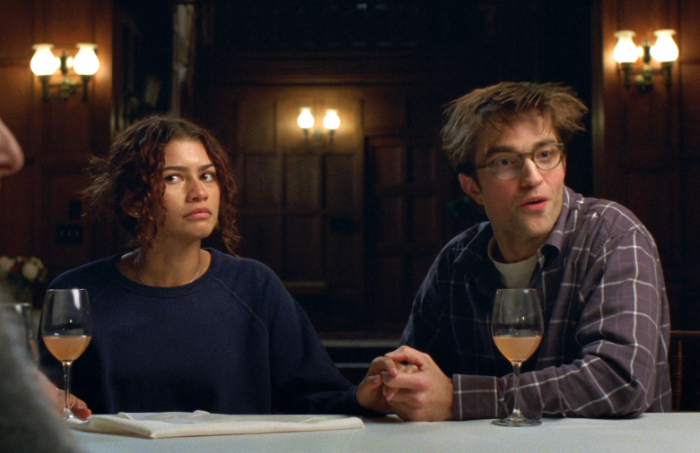
After a pleasant beginning in which Emma (Zendaya) and Charlie (Robert Pattinson) are shown with great chemistry, a couple with no problems a week before their marriage, there is a turn at a dinner with Mike, the best man (Mamoudou Athie), and Rachel, the maid of honor (Alana Haim). When the group begins lightheartedly confessing to the worst thing they’ve done, each person gives a quite innocuous response until Emma reveals that she had planned a school shooting when she was younger.
This revelation punctures the lightness of the beginning of the film and focuses the film on the flip side of the rom-com question: “what if chance did lead them down that specific path.” The traditional formula of the beauty of chance is juxtaposed with the horror of chance.
Charlie must fundamentally rethink his perception of Emma just a week before their wedding. In this process of internal conflict, Charlie is faced with multiple moments in which he also engages in that flipped question of the horrible possibility of chance as his fantasies and actions are clouded by Emma’s confession.
The focus on possibility is reflected not just in story, but in the editing of the film. Borgli uses frequent cuts that allow for him to portray the two possibilities of a single action; a character will be doing something and Borgli will portray the possibility that it goes wrong and then abruptly cut back to reality. This formal quality is able to imbue the film with the anxieties of the characters as well as the anxieties inherent in its premise.
Rachel brings conflict to the film, seeing Emma’s confession as an irreconcilable mark against her character, despite her complete change of character since her planning of the school shooting fifteen years before. What is so significant about Rachel and the anxiety her offense produces is it shows the film’s implicit critique of bourgeois morality. The characters of the film have swanky, desirable jobs at museums or well-designed offices and have signifiers of a sophisticated, liberal existence like a stylish apartment, hundreds of books and sweatshirts from literary magazines like Harper’s. They live a fundamentally bourgeois existence, and the fear of cancellation from Rachel shows the way the film’s anxieties also stem from class fears and the specifically scolding attitudes and aversion to forgiveness dominant in the liberal bourgeois conscience.
What is so fantastic about the film is the way that it leads to a reconciliation of the two opposing possibilities of possibility, the meet-cute and the intrusive thought, in a way that allows the couple to disavow from the stifling and unforgiving conventions of their class.