2015 was a great year for video games, with popular series like Metal Gear Solid and the Witcher receiving new additions, and fresh standalones like Bloodborne also being released. However, the independent developer Toby Fox released something of his own that year: Undertale, an Earthbound-inspired RPG where the core idea was that the player’s choices mattered, and they could not be undone easily. The game took off, quickly placing it on a pillar as one of the best indie games out there.
Then, in 2017, Toby released a demo for his new game, Deltarune.
The demo contained all of chapter one, and later chapter two, for free, and later a paid expansion for chapters three and four (new chapters will be released as free updates). The game was similar to Undertale, with similar mechanics like the classic ACT button, the bullet hell style turn based combat and even a few returning characters even though the two games are confirmed to be separate from each other.
The stories, however, couldn’t be more different. While Undertale works hard to drive home the point that the player’s choices have consequences, Deltarune does the opposite, taking the first opportunity to tell the player that their choices don’t matter. To emphasize that, the game tosses aside the “custom character” designed by the player, and throws them into the body of Kris, the main character of the story.
The story begins after Kris and the class bully Susie are sent to get chalk from the storage closet by their teacher, and they fall into the Dark World, a place where everyday objects gain a life and personality of their own. They encounter Ralsei, a prince who knows more than he wants to (or is willing to tell), and set off on their adventure. After their adventure is over, Kris goes home, and then the player gets an unsettling revelation: Remember what I said about being “tossed” into Kris’s body? It isn’t Kris who calls their own shots. It’s the player.
Moving away from the heavy lore implications, it’s time to talk about the game’s elements.
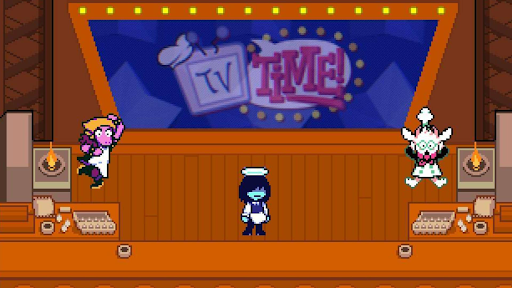
The art style of Temmie Chang, the lead artist, brings the atmosphere of the game’s various Dark Worlds to life. From the eerie trees and chess-themed enemies in chapter one’s aforementioned Card Kingdom to the goofy, gag-filled TV World of chapter three the stark contrasts and unique mechanics of each chapter make them each a special joy to play through.
Speaking of the unique mechanics, each chapter has a variety of puzzles, often leading to a secret boss fight. Chapter two contains a variety of typing puzzles, and chapter four has the piano puzzles and mazes that require the player to look at echoes to determine where they are.
The music is something that never gets old. The boss themes range from super intense to some of the goofiest tracks ever, and standard battle themes are impossible to get tired of. The main world themes, thanks to compositions by Fox, are all really catchy and fun to listen to. Among my favorites are chapter three’s main theme, “TV World,” and I was honestly surprised that I didn’t mind listening to it for so long in one of the longest chapters.
I was actually a little sad when that music was replaced with another track for the main hub. While the main boss themes are all epic, with greats like “Black Knife” “Knock You Down!” and “It’s TV Time!” all being amazing, the theme concluding chapter four beats them all. “GUARDIAN” starts out slow and menacing, but after a gradual crescendo, the song enters into a fast paced, heroic-sounding beat.
The secret boss themes are some of the best, and the best part is that they each incorporate a key motif dubbed the “Freedom Leitmotif” (by fans, anyway). The top scores in this category go to chapter four’s “Hammer of Justice” (lots of good songs in this chapter) for the way the music syncs to different parts of the fight and chapter one’s “The World Revolving” for its chaotic nature and, again it happens to sync up to key parts of the fight occasionally. An honorable mention goes to “Catswing” whose associated boss is so out of the way that I had to Google it in order to find it. Unsurprisingly, it is also from chapter four. I was pleasantly surprised that it was jazz-themed.
The title isn’t misleading, as the next topic is what might come next. At the end of chapter four, it is revealed that Ralsei was not telling the whole story of the prophecy at the beginning of the game because it doesn’t exactly have a “happy ending” for everyone. Many people theorize that the player themself is the true villain of the game. Theories for the setting for the next chapter include it being in a “vast garden” of some sort. Kris’s father, Asgore, owns a flower shop, or perhaps a garden. Because of this, one of the theories in circulation is that the next chapter will focus around Asgore and the implications of the prophecy’s true ending, with Susie, Kris and Ralsei trying to avert it. Personally, I look forward to it. I’ve beaten all four secret bosses, and done almost everything, so I am excited for more from Toby Fox and his team.